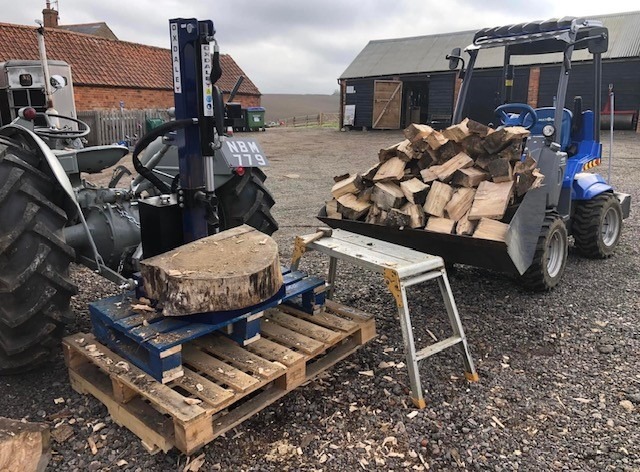
Heavy-Duty Log Splitters for Farms, Estates and Contractors: What Matters Beyond Tonnage?
BY OXDALE PRODUCTS
You’d be forgiven for looking for the best splitting force when considering industrial log splitters, but a high tonnage figure doesn’t tell a farmer, estate manager, or contractor whether a machine will be the most productive option over repeated use.
Beyond tonnage, there are several log splitter factors to consider before buying one. These include cycle speed, log handling, build quality, power source, and often forgotten or not considered, servicing and manufacturer support. With this in mind, it might surprise you that two splitters that possess similar force perform differently over a full day’s work.
Heavy-Duty Log Splitters for Farms, Estates and Contractors: What Matters Beyond Tonnage? 2
Why Tonnage Is Only Part of the Picture
We’re not denying that tonnage is important when buying a heavy-duty log splitter, but it shouldn’t be the defining factor that influences you to buy one machine over another. Buying solely based on the force available for the most awkward log you might encounter could leave you with an awkwardly sized machine for the vast majority of your work.
It’s important to buy based on the timber you process regularly, taking into account typical diameter, knots, grain, moisture and general timber condition. If you know for a fact you encounter large, knotted hardwood, you may need a heavy-duty splitter with high tonnage. Otherwise, another splitter may be more suitable.
Compare Cycle Time and Working Productivity
When buying a heavy-duty log splitter, some people can get bogged down in pure splitting force when cycle time and work productivity are likely to be bigger factors. When comparing models, be sure to consider how much timber the machine can process across a working session, not simply whether it can complete one difficult split.
The speed in which the ram extension and ram return are performed can make a big difference to productivity across a working day. A quicker full cycle time that saves seconds each time adds up over a long period of time. For commercial use, you need to consider how the splitter helps with repeated workflow.
Consider How the Machine Handles Large Logs
When we say consider how the machine handles large logs, we don’t just mean splitting force; we actually want you to think about how the splitter makes dealing with larger logs in general easier.
If you’re dealing with larger logs on a regular basis, and they are difficult to load or position into your chosen log splitter, this can seriously hamper productivity and overall efficiency. For estate teams, farms and forestry contractors, you need a machine that can easily deal with large logs in all aspects.
In some cases, vertical splitting is the best solution; this is because it reduces the need to lift heavy logs onto a raised beam. When comparing heavy-duty log splitters, be sure to take a keen look at how stable the working area is and consider how easy it would be to position irregular timber onto the splitter.
Look Beyond the Specification Sheet to Build Quality
Build quality is the difference maker, especially when it comes to industrial log splitters. These are machines that need to be built well, constructed of strong material and durable enough that they reflect the investment you make in them.
Our manufacturing team here at Oxdale Products have been building durable log splitters for more than 20 years, with their focus spread across a variety of parts of a splitter to ensure our customers can rely on our splitters. Frame construction, machine stability, splitting wedge design, hydraulic hoses and fittings should all be considered with long-term splitting in mind.
Internally, some of the most important parts of a splitter, such as the cylinder and hydraulic components, should be built using high-quality materials that can keep up with heavy and repeated use.
Choose a Power Source That Fits the Job
When using a log splitter on your farm, estate or in a professional capacity, you need to consider which power source is most suitable for you.
PTO and Tractor Hydraulic Splitters
For farms and estates already operating tractors with PTO or hydraulic compatibility, this power type makes the most sense. A PTO log splitter harnesses the power of the tractor and is easily manoeuvrable.
Petrol and Electric Splitters
Petrol splitters allow you to independently operate in places where mains electricity is unavailable and it is not possible to reach in a tractor to harness a PTO splitter. Electric splitters are perfect for fixed locations where a suitable supply is available.
Factor Parts, Servicing and Downtime Into the Purchase
As a farmer, estate team or general contractor, you need a splitter that makes sense for you and your business. One thing you need to consider as a business is how easy the machine is to keep in working order and, should it develop a fault, how easy it is to service and secure parts.
Something very few think about when buying a log splitter is what it’s going to be like after they’ve bought it. While you’ll likely be aware of how it will improve your productivity and save you time, you should also be considering warranty, routine servicing and how helpful the dealer would be should you need advice.
As a business, efficiency and value for money are two of the most important factors when buying any machinery, which is why finding out more about the dealer or manufacturer is important.
Heavy Duty Log Splitter Buying Checklist
Before you buy your heavy-duty log splitter, follow our checklist to ensure you are getting the right machine for the job. Points to consider include:
What timber species and diameters do you usually process?
How frequently will the splitter be used?
What is the machine’s cycle time?
How much lifting and repositioning is required?
Which power source suits your working environment?
Is your tractor compatible if considering PTO or hydraulics?
How accessible are parts and servicing?
Is the machine designed for your expected workload?
Explore some of the most frequently asked questions about heavy-duty log splitters.
Does Higher Tonnage Mean a Better Log Splitter?
While higher force can help with demanding timber, cycle speed, construction, handling and workload suitability also matter.
What Makes a Log Splitter Suitable for Commercial Use?
A splitter suitable for commercial work is one that can sustain workload, reliable hydraulics, sensible handling, appropriate power, durable construction and access to parts/support.
To provide the best experiences, we use technologies like cookies to store and/or access device information. Consenting to these technologies will allow us to process data such as browsing behavior or unique IDs on this site. Not consenting or withdrawing consent, may adversely affect certain features and functions.
Functional
Always active
The technical storage or access is strictly necessary for the legitimate purpose of enabling the use of a specific service explicitly requested by the subscriber or user, or for the sole purpose of carrying out the transmission of a communication over an electronic communications network.
Preferences
The technical storage or access is necessary for the legitimate purpose of storing preferences that are not requested by the subscriber or user.
Statistics
The technical storage or access that is used exclusively for statistical purposes.The technical storage or access that is used exclusively for anonymous statistical purposes. Without a subpoena, voluntary compliance on the part of your Internet Service Provider, or additional records from a third party, information stored or retrieved for this purpose alone cannot usually be used to identify you.
Marketing
The technical storage or access is required to create user profiles to send advertising, or to track the user on a website or across several websites for similar marketing purposes.