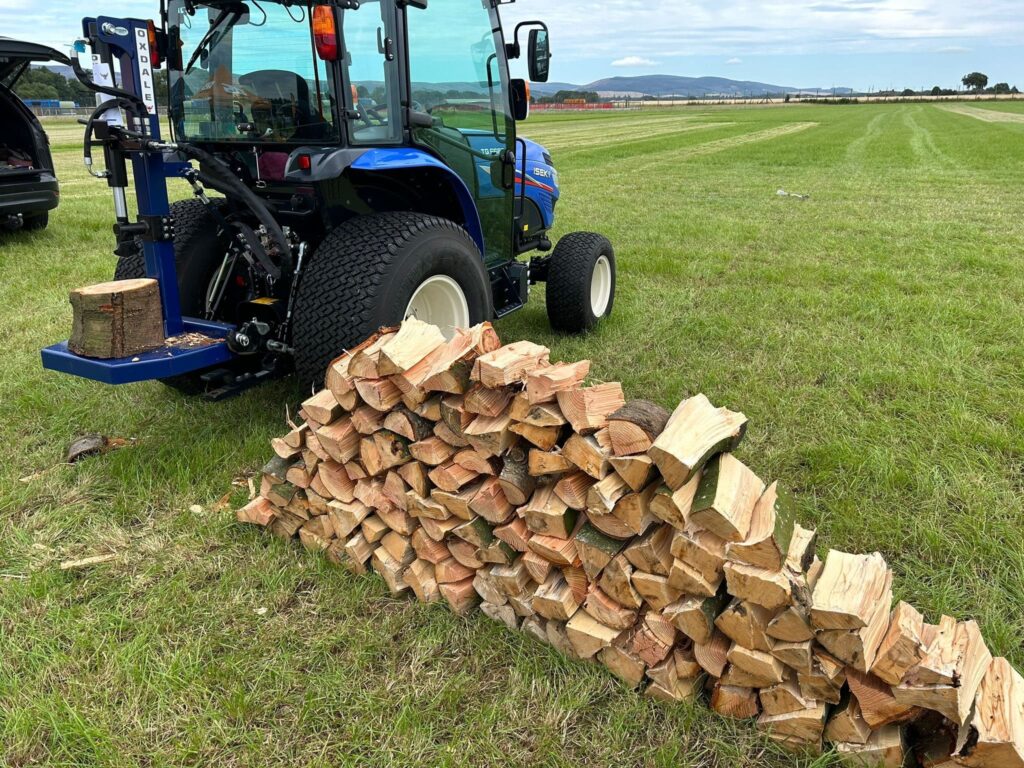
If you’ve ever wondered how to split a log without excessive labour and an increased chance of injuring yourself, you will have considered the use of a log splitter. Here at Oxdale Products, we have been manufacturing log splitters for more than 20 years, helping farmers and agriculturists save time, money and their backs with our efficient splitting machines.
They are simple, yet brilliant, machines that require little input to operate. As with all heavy machinery, they need to be operated safely. Below is a quick guide on how to split large logs with ease and maximum safety.
How to Split Large Logs Efficiently 2
1. Identify and Prepare Workspace
Before you get started, you need to assess your workspace. Ensure that it is clear with the splitter situated on level ground to guarantee stability. An unstable log splitter runs the risk of being incredibly dangerous, so be sure to always start with this step.
2. Put on Safety Gear (PPE)
Safety gear such as eyewear (goggles) or shield, gloves and more are all necessary when operating a log splitter. One piece of PPE we often hear operators overlooking is ear protection, such as earplugs. We must stress that our machines do come with built-in safety features, but your own precautions should be taken.
3. Assess Log Splitter Before Use
Familiarise yourself with your machine if it is your first time using it. Equally, if it is a machine you’ve used plenty of times, look for signs of damage or decay that could be detrimental to operation. For example, if stored outdoors, check for signs of rust or the effects of the weather. Also, check the wiring to ensure no rodents have chewed through it, causing damage.
4. Select and Prepare Logs
It is important to assess the logs you wish to split before lifting them onto the splitter. Ideally, you want to select logs that fit in line with the manufacturer’s size guidelines and are also dry. Wet logs can be dangerous and harder to split. Typically, manufacturers’ guidelines will suggest that there is no limit on log diameter, but instead height.
5. Position Log Correctly
Large logs require more force due to their greater mass, which highlights the importance of correctly positioning your log on the splitter. Whether it is a vertical or horizontal log splitter, ensure the log is stable and centred with the wedge aimed to drive through the centre of the mass.
6. Operate Splitter (Step-By-Step)
Switch the machine on, ensuring the emergency stop is accessible.
Use the control lever or button to advance the ram slowly into the log. Do not attempt to push the log while the ram is moving. The splitter will have ample force.
If the log does not split fully on the first pass, retract the ram, reposition the log (rotate 90° or move to another point), then repeat. For very large logs, use a quartering technique: split into halves, then split each half again.
When splitting is finished, fully retract the ram and remove the split pieces before placing the next log.
7. Clean Up and Maintenance
Cleaning up and further maintenance is a short job at the end of splitting logs that can save you time and money in the long run. Taking care of your splitter by removing any debris from the machine will stop a buildup that could cause the machine to malfunction. Once powered off, sweep away any debris from the machine. Assess the machine for any wear and tear that needs noting. Be sure to service your machine regularly to maintain effectiveness and safety.
Browse British-Built Log Splitters at Oxdale Products
Interested in saving yourself time and money by using a log splitter on your site or farm? Why not explore the Oxdale Products range of log splitters, including petrol, electric and PTO options to suit your power needs. For more guides, tips and tricks like this, head to the Oxdale Products blog to find out how to get the most out of your machinery.
To provide the best experiences, we use technologies like cookies to store and/or access device information. Consenting to these technologies will allow us to process data such as browsing behavior or unique IDs on this site. Not consenting or withdrawing consent, may adversely affect certain features and functions.
Functional
Always active
The technical storage or access is strictly necessary for the legitimate purpose of enabling the use of a specific service explicitly requested by the subscriber or user, or for the sole purpose of carrying out the transmission of a communication over an electronic communications network.
Preferences
The technical storage or access is necessary for the legitimate purpose of storing preferences that are not requested by the subscriber or user.
Statistics
The technical storage or access that is used exclusively for statistical purposes.The technical storage or access that is used exclusively for anonymous statistical purposes. Without a subpoena, voluntary compliance on the part of your Internet Service Provider, or additional records from a third party, information stored or retrieved for this purpose alone cannot usually be used to identify you.
Marketing
The technical storage or access is required to create user profiles to send advertising, or to track the user on a website or across several websites for similar marketing purposes.